 Canadian and Family Owned
Stop Leaving Money on the Table: The Ultimate Guide to Menu Optimization
.png "Restaurant with tables and chairs with menu on table")
Stop Leaving Money on the Table: The Ultimate Guide to Menu Optimization
Have you ever wondered why some restaurants thrive despite rising ingredient prices, while others struggle to break even? The secret rarely lies in cutting corners or compromising on quality. Instead, the most profitable operators treat their menus like living, breathing profit-optimization tools. If you simply view your menu as a list of dishes and prices, you are leaving money on the table.
Understanding the deep mechanics of your menu can completely transform your bottom line. By leveraging data, psychology, and strategic design, you can subtly guide your guests toward choices that satisfy their cravings while maximizing your profit.
This guide breaks down the core elements of menu optimization, from calculating the true value of a dish to using visual hierarchy to your advantage.
The Core Metric: Contribution Margin
Before you can optimize your menu, you need to understand exactly how much money each dish brings in. This is where the Contribution Margin (CM) comes into play. It serves as the core financial metric behind every successful menu decision.
The formula is incredibly simple:
Contribution Margin = Menu Price – Food Cost
Why does this matter? Many operators fall into the trap of chasing the lowest food cost percentage. However, percentages do not pay the bills; gross profit dollars do. The contribution margin reveals the actual dollar profit you make on every single plate.
Actionable steps for managing your CM:
- Track your contribution margins weekly or monthly, rather than waiting for seasonal menu overhauls.
- Visually and verbally promote your high-margin items.
- Bundle or upsell high-CM additions, such as premium sides, specialty beverages, and desserts.
- Focus your efforts on the highest dollar profit rather than obsessing over an arbitrary food cost percentage.
The Menu Engineering Matrix: Categorize for Profit
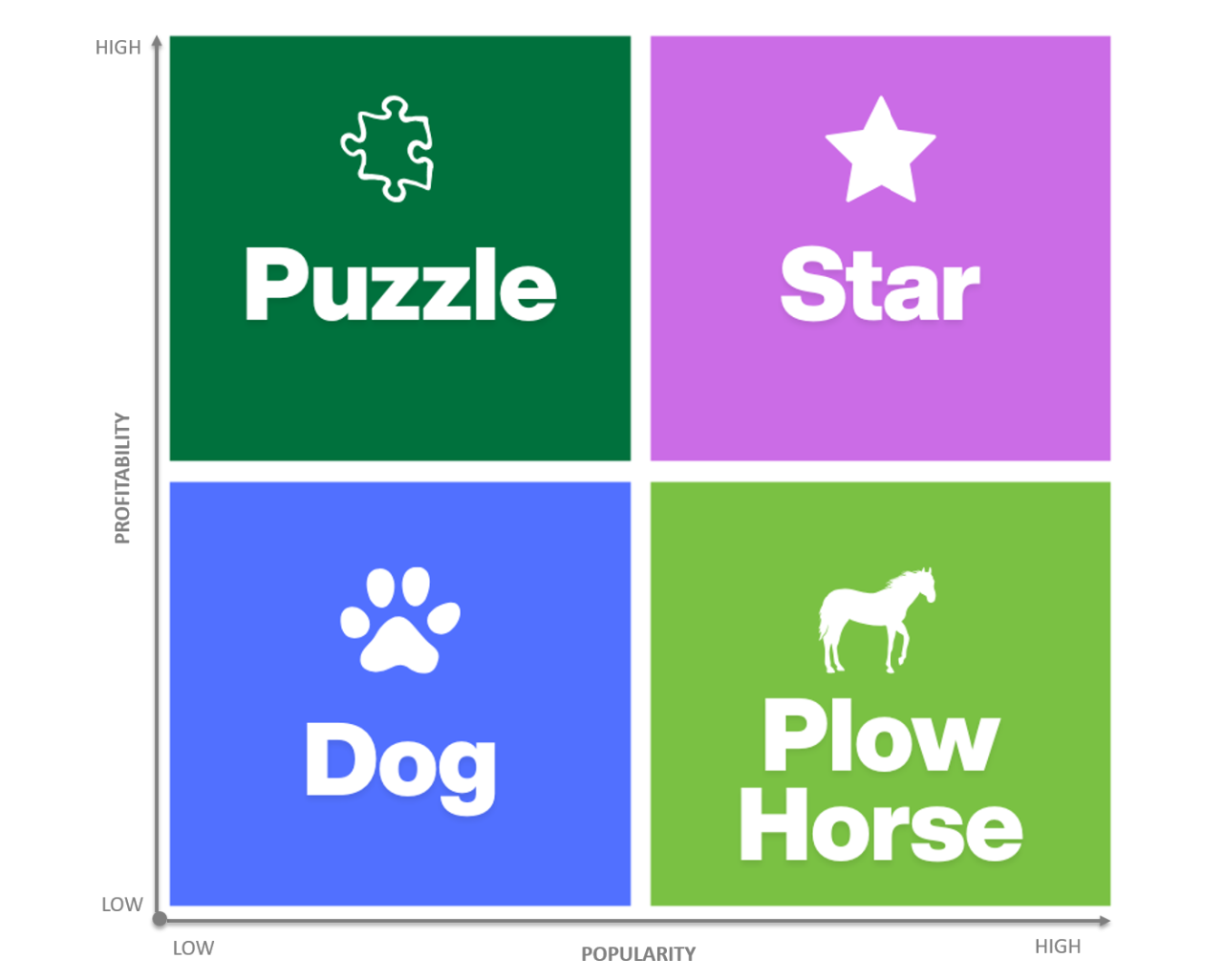
Once you know your contribution margins, you can implement the Menu Engineering Profit and Popularity Matrix. This system categorizes every item on your menu based on two factors: how often it sells (popularity) and how much profit it generates (contribution margin).
Every dish falls into one of four distinct categories:
1. Stars (High Profit, High Popularity)
These are your best items. They drive your revenue and keep guests coming back.
Strategy: Feature them prominently on your physical menu. Maintain strict consistency in their preparation and never remove them from your offerings.
2. Plowhorses (Low Profit, High Popularity)
Guests love these items, but they do not leave you with much cash at the end of the night. Think of the massive, expensive-to-produce burger that everyone orders.
Strategy: Raise the price slightly. Alternatively, reduce the portion size or tweak the ingredient list to lower your food cost without sacrificing the core appeal of the dish.
3. Puzzles (High Profit, Low Popularity)
These dishes make you great money, but guests rarely order them.
Strategy: Give these items a facelift. Improve their naming, move them to prime locations on your menu, and train your staff to actively upsell them.
4. Dogs (Low Profit, Low Popularity)
These items take up valuable kitchen prep time and menu space without delivering sales or profit.
Strategy: Remove or replace them immediately. The only exception is if they serve a specific strategic purpose, such as a necessary dietary or vegan option.
The Psychology of Menu Anchoring
You can guide guest choices through behavioural pricing. Anchoring uses human perception to make specific prices feel more reasonable. Consider a menu that features a $68 premium steak. Even if very few people order it, that steak serves a crucial purpose: it acts as a high-price anchor. Suddenly, the $38 entrée right next to it looks like a fantastic deal.
Effective behavioral pricing tactics:
- Use decoy pricing: Add a slightly less appealing option to steer guests toward the dish you actually want them to buy.
- Ditch the dollar signs: Removing the "$" symbol reduces the psychological "pain of paying" for the guest.
- Optimize price formatting: Display prices simply as "34" instead of the formal and intimidating "$34.00."
- Implement price ladders: Offer three tiers for specific items (good, better, best) to capture different spending comfort levels.
- Try odd-even pricing: Pricing an item at 19 instead of 20 increases the perception of value.
Visual Hierarchy: Controlling the Eye Flow
Your guests do not read your menu from top to bottom like a book. They scan it. Because of this, you must strategically place your most profitable items in prime real estate zones.On a standard single-page menu, the top-right corner is the most viewed area. Additionally, guests typically remember the first and last items in any given section.
Design strategies to capture attention:
- Place your Stars and high-CM Puzzles in these high-visibility zones.
- Use subtle visual cues like icons, boxes, or intentional whitespace to draw the eye to specific dishes.
- Avoid visual clutter. Limit total items to a sweet spot of 7 to 10 choices per category. Less choice consistently leads to higher conversion rates and faster table turnover.
- Group items logically, flowing naturally from Appetizers to Mains to Add-ons.
Sell the Story with Descriptive Psychology
The words you use directly impact the perceived value of your food. Simple, uninspired names do nothing to justify your pricing. Consider the difference between these two descriptions:
Grilled Chicken
Herb-marinated free-range chicken, flame-grilled
The second option sounds premium. This descriptive psychology increases perceived value, allowing you to support higher pricing while driving better conversion rates on your high-profit "Puzzle" items.
The Overlooked Element: Server Influence
A brilliantly engineered menu cannot work alone. Your front-of-house staff plays a massive role in driving your sales mix. You must train your servers to act as salespeople, not just order-takers. Train your staff to push high-CM items proactively. Equip them with suggestive selling scripts, such as, "The most popular dish tonight is our..." or "Guests usually love to pair that entrée with..."
The Iteration Cycle: Keep Evolving
Top operators treat their menus as a continuous work in progress. Do not wait for a new year to make changes. Follow a strict menu iteration cycle. Every 30 to 90 days, sit down and review the data. Track your shifting sales mix percentages and recalculate your contribution margins. Adjust your pricing, shift the placement of underperforming items, and tweak your naming conventions based on what the numbers tell you.
Maximize Your Menu's Potential
A high-performing menu is a powerful tool for profit optimization. By engineering your offerings, prioritizing contribution margin over food cost percentages, and applying design psychology, you take control of your financial success.